
Ten minutes of sound you can walk around
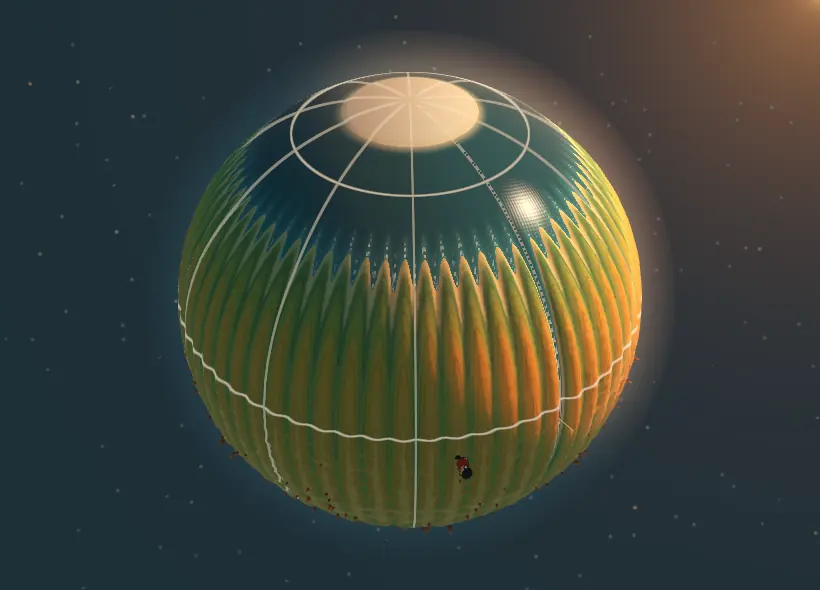
Every track has its own shape. We wrapped its real spectrogram around a sphere and got a planet where one turn equals the whole track.
First, the siren. In closed headphones you may not hear an air raid alert. Keep an alert app with vibration on, listen with one ear or in transparency mode. Not while driving and not outdoors. During a threat, shelter comes first.
How to read a planet
One turn is 10 minutes
Longitude is time: one turn equals the whole track. Latitude is frequency: from 40 Hz in the south to 16 kHz in the north, on a log scale. Height is energy.
The height scale is the same on every planet: one decibel lifts the ground by the same amount. Anything quieter than −18 dB is under water. The relief is exaggerated so that you can see it.
- 600 s
- track length
- 40 Hz – 16 kHz
- pole to pole
- 256 × 1024
- spectrogram rows and columns
This is not an illustration, this is the file. Pale caps at the poles mean there is no data there. Trees grow where a note is loudest.
The breathing planet
60 even dunes in one turn
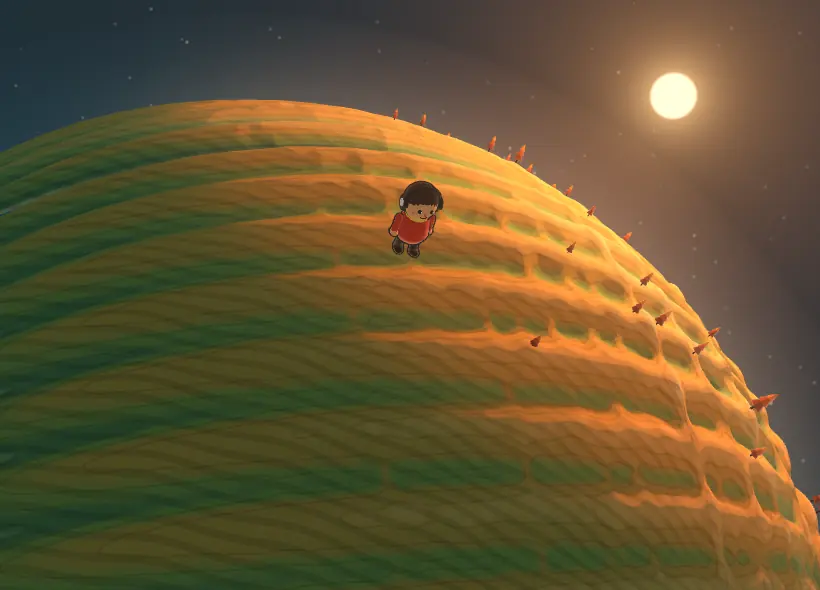
The breathing wave lifts and lowers the noise every 10 seconds. In a spectrogram these are stripes, here they are dunes a person walks across. Six breaths a minute, no voice.
The dune crests were found in the file itself, not drawn: the spectrogram has 60 of them, with a median step of 9.96 s.
- 10 s
- dune step
- −23.5 LUFS
- track loudness
In closed headphones you may not hear a siren.
Review of breathing exercises (Fincham 2023): anxiety g = −0.32, a small to medium effect. That is about breathing in general, not this track.
The masking planet
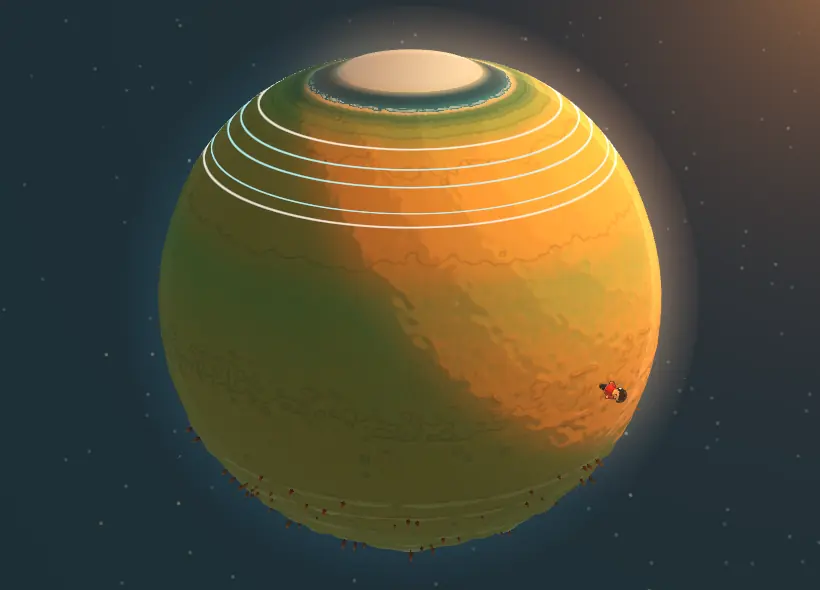
A wide plateau where the drill whistles
The noise puts 37.4 % of its energy into the 4–8 kHz band. On the planet that is a wide plateau near 12.8 dB. The three rings are published drill sound peaks: 4479 Hz, 5600 Hz, 6570 Hz.
Masking has not been tested on a real drill. The sound does not cover vibration through bone: headphones do nothing about it.
- 37.4 %
- energy in 4–8 kHz
- 360 s
- track length
- −20.2 LUFS
- track loudness
In closed headphones you may not hear a siren.

The sleep planet
Smooth, and at the end it goes under water
No notes and no step here: only even brown noise sloping slowly from low frequencies to high. Walking on this planet is boring, and that is the point.
The fade lasts 3 minutes from 9:00. The relief visibly drops from 9:44, the land sinks, and the end of the track lies under water.
- 12:00
- length, min:s
- 9:00
- fade starts, 3 min
- 9:44
- relief visibly drops
- −30.5 LUFS
- track loudness
In closed headphones you may not hear a siren.
The control planet
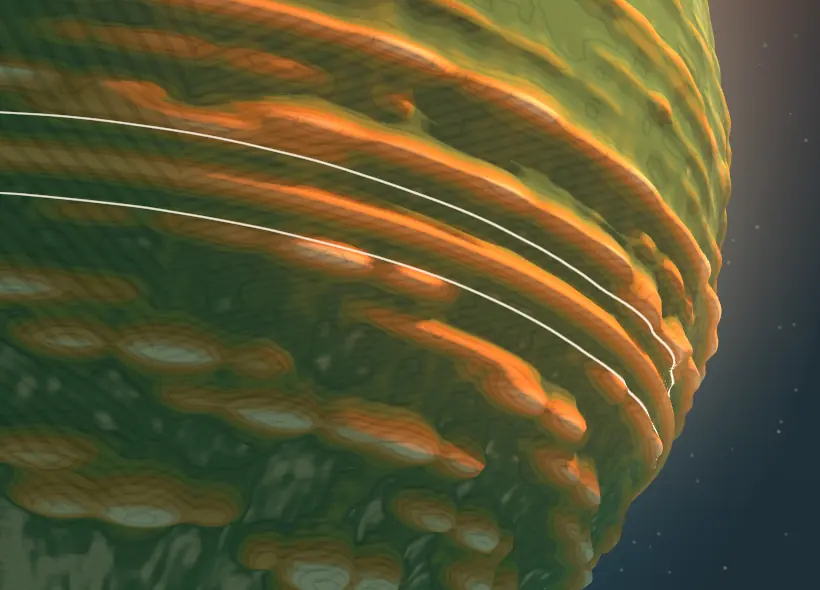
A clean canyon with one ridge in the middle
The music in this test has no tones in the 200–240 Hz band. So the band lies as a canyon with a floor near −6.5 dB, and inside it stands the carrier ridge at 33.8 dB.
Left ear 220 Hz, right ear 220 Hz, difference 0 Hz. The other two planets of this test differ only in this ridge: 217 and 223 Hz, difference 6 Hz; 215 and 225 Hz, difference 10 Hz.
- 0 Hz
- difference between ears
- 33.8 dB
- ridge height
- −6.5 dB
- canyon floor
The sound of this planet does not play here: a blind test is running and it must not be known by ear.
Honestly
What this sound does and does not do
- Beats did not beat music. A trial of 90 patients before wisdom tooth removal: music and beats were both better than silence and did not differ from each other, p = 1.
- Music helps a little. A meta-analysis of 16 studies: anxiety SMD −0.50 during treatment under local anaesthesia, low certainty. Music people chose themselves gives −1.01, music the authors chose −0.24. Our track is in the second group.
- The brain follows beats weakly. The cortex follows them less than monaural beats, and mood did not change. A review of 14 papers: 5 for, 8 against, 1 mixed.
- Not tested on a drill. The trials ran before treatment, not during drilling. Nobody has measured our masking on a real drill, and the sound does not cover vibration through bone.
- This is not treatment. The sound does not relieve pain and does not replace anaesthesia or sedation. That is the doctor's decision.
Walk it yourself
Press and the person walks the planet in real time: their position equals the second you are hearing. Drag the planet to see what is ahead.
First, the siren. In closed headphones you may not hear an air raid alert. Keep an alert app with vibration on, listen with one ear or in transparency mode. Not while driving and not outdoors. During a threat, shelter comes first.
Keep the volume comfortable. WHO and ITU standard: 80 dB for up to 40 hours a week for adults. Masking needs volume, so keep its duration in mind.